






Improving the Digital Economy through A.I and IoT
The world has gone digital. From the news, politics, finance, health, mobile phones and on to education; everything has some form of a digital footprint. Today, people have access to abundant...

The world has gone digital. From the news, politics, finance, health, mobile phones and on to education; everything has some form of a digital footprint.


Today, people have access to abundant data and information on virtually every subject on this planet. The advent of the internet and computer technologies over the past century, has led to the digitisation of all sectors and all affairs of human life, including the economy.
The economy of any country is pivotal to its inherent progress, and Nigeria is no exception. Nigeria, a country with vast resources, is only beginning to look to harness the power of modern technology.
The country has an expanding economy with ample human capital and the economic potential to lift millions out of poverty.
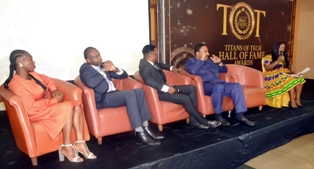
Some experts believe that to reduce the ever-widening gap, and bridge the digital divide, Nigeria needs to switch fully to a digital economy, with the adoption of A.I and IoT. This was the core of submissions at the Titans of Tech 2021 Roundtable, aptly themed: “Harnessing the potential of AI, IoT for Transformation of the Digital Economy.”
A.I (artificial intelligence) refers to the simulation of human intelligence in machines and technological applications that are programmed to think like humans and mimic their actions. IoT on the other hand, denotes the network of physical objects (things) that are embedded with sensors, software, and other technologies for the purpose of connecting and exchanging data with digital devices and systems over the internet.
These devices range from ordinary household objects to sophisticated industrial tools. With more than 7 billion connected IoT devices as at 2018, experts projected this number to grow to 10 billion by 2020 and 22 billion by 2025.
A tech expert, Mr. Olatayo Ladipo Ajai, Manager, Country Head InfoBip Nigeria, stated that IoT has become one of the most important technologies of the 21st century. He said “human beings can now connect everyday objects—light bulbs, kitchen appliances, cars, thermostats, televisions—to the internet via embedded devices, and conversational A.I., which enables the seamless communication between gadgets, people, and processes.”
He noted that the world is gearing towards digital trade, digital health, digital education, digital agriculture, digital security and Nigeria needs to grow in these aspects, so that it is not left behind.
Mr. Lare Ayoola, CEO of IoT Africa and Tranter IT Infrastructure services, stated that the combination of mobile computing, analytics, and cloud services, all of which are fueled by A.I and the Internet of Things (IoT), is going to transform the digital economy.
He said “by means of low-cost computing, the cloud, big data, analytics, and mobile technologies, physical things can share and collect data with minimal human intervention. In this hyper connected world, digital systems can record, monitor, and adjust each interaction between connected things. The physical world meets the digital world—and they cooperate.”
Mr. Lare Ayoola, outlined the impact of IoT on the various supply chains in Nigeria, and how IoT management will transform inventory, logistics, manufacturing, distribution, construction, agriculture, security companies, and more.
He cited examples of how IoT can signal agronomists and farm owners on the state of livestock, how crops are faring on a farm site, or a rise or decrease in temperature of a storage grain silo.
He noted that “the applications of IoT are limitless. It saves time, eliminates waste, maximizes profits, reduces anxiety, monitors environments, enhances security, and optimizes businesses to achieve maximum profits. It will save Nigerians from agricultural losses, post-harvest losses, financial, operational and resource losses. The adoption of A.I and IoT, is the gateway to the future of a sustainable digital economy.”
Another tech professional, Engineer Ikechukwu Nnamani, the CEO of Medallion Communications, remarked on the potential A.I and IoT has to offer Nigerians.
“A vast majority of Nigerians are not aware of the tremendous benefits A.I and IoT have, and its diverse applications. A decade ago, people had to commute for hours before reaching their workplaces, and commute for long hours back to their homes. Technology has devised easier, more convenient ways to work from home, attend virtual meetings and conduct financial transactions on the go.”
“With just a click, you can order food, purchase items online, buy stocks, etc. No need to go physically. Cool right? This is because Nigeria is gradually transitioning from a traditional position to a modern viewpoint on conducting business activities, a shift to a digital economy.”
“However, the pace at which this transition is taking place is slow, hindered by several impediments. Lack of digital infrastructures is a major challenge towards growth in the digital economy.”
Engineer Ikechukwu stated that “for digital technologies to impact the digital economy, appropriate policies must be put in place to eliminate the obstacles preventing emerging markets from fully engaging in the digital economy and optimising the benefits.”
“The digital economy runs on digital infrastructure. The more digital infrastructure that is deployed, the faster the country can make the transition from the traditional economy to the digital economy. Priority should be given to the improvement of infrastructures, like power development, data centres, and solar energy explorations among others.”
In her remarks, Mrs. Tinuade Ogunfuyi, Head, Core Networks and Solutions, at Information Connectivity Solutions Limited (ICSL) stated that “the benefits of IoT the digital economy for emerging markets like Nigeria, are potentially large. This is because these technologies offer productivity-boosting opportunities, increased access to digital products and services that help optimise processes and production, reduce transaction costs, and transformation of supply chains.”
She noted that “increased reach to millions of consumers, encourage investment and adoption of digital technologies. This drives firms to participate in global value chains and directly access customers in foreign markets in ways previously only feasible for large and established companies from advanced economies.”
If the goal is to improve the digital economy, A.I and IoT must be on the front burner. And it must be adopted in all sectors and industries pertaining to the digital economy.
Experts who spoke at the Titans of Tech Roundtable conceded that SMEs, MSMEs, businesses, organisations, telecommunications, information systems, cloud services and the government, must put these solutions in place to improve the digital economy.
The government can generate revenue from the sale of the internet spectrum and other licenses. The government must now take the lead to digitalise its own services. It can start by urgently setting up an IoT working committee, training centres for youths, and institutions for tech learning.
Undoubtedly, an improved digitalised economy will positively impact the gross domestic product (GDP), reduce costs and provide operational efficiencies to a multitude of businesses across all states in Nigeria.
With its potential for good, Dr Chris Uwaje posited that it is now imperative to institute an IoT Working Group to help the country optimize these technologies.
A.I and IoT will lead enable economic progress and lead Nigeria to the future it seeks.


No Comment! Be the first one.