






Meet ‘Pibot,’ The Robot Who Can Fly Planes
First-of-Its-Kind Robot At the Korea Advanced Institute of Science & Technology (KAIST), a team of researchers has built a humanoid robot that can operate most airplanes. The humanoid, dubbed...

First-of-Its-Kind Robot
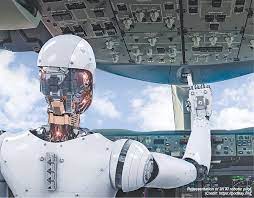
At the Korea Advanced Institute of Science & Technology (KAIST), a team of researchers has built a humanoid robot that can operate most airplanes. The humanoid, dubbed “Pibot,” can pilot an aircraft without majorly modifying the cockpit.
Pibot resulted from the collaboration of Professors David Hyunchul Shim, Jaegul Choo, Kuk-Jin Yoon, and Min Jun Kim. The robot can fly a plane just like a pilot by manipulating all the single controls in the cockpit. It can grasp control and maintain altitude even in the harshest conditions.
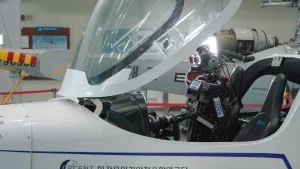
The bug-eyed humanoid designed for sitting and working measures 160 cm tall and weighs 65 kg. According to Shim, Pibot‘s human form may not be super efficient, but they designed it to be a humanoid form since everything in the cockpit is built for humans. It uses high-precision technology to control its arms and fingers to operate an aircraft, even with severe vibration. In addition, it can communicate with air traffic controllers and humans in the cockpit using voice synthesis.
Unlike conventional robots designed for preprogrammed or repetitive tasks from a fixed position, Pibot can assess the plane’s situation using multiple cameras. It has built-in external cameras designed to keep track of the aircraft’s current state and internal ones, which helps it manage important switches on the control panel. Shim boasts that this serves as Pibot‘s key feature, distinguishing it from automated systems such as autopilot or uncrewed airplanes.
As the world’s first humanoid pilot, Shim believes that Pibot is more capable than human pilots because it uses large language models to memorize documentation instead of flipping through printed-out manuals. It also can remember all the air routes like the Jeppesen Chart, an aeronautic tool composed of navigational information, flight planning products, and operations planning functions.
The KAIST researchers plan to have Pibot fly an actual aircraft before 2026, from takeoff to landing. They must settle further technical and regulatory challenges for their real flight test. Shim believes that Pibot can replace humans in dangerous jobs since it can drive cars, operate tanks, or even command ships.
Other Innovative Aviation Projects
As artificial intelligence expands to more fields, government agencies have also started building planes with built-in AI systems. For instance, the U.S. Department of Defense collaborates with Lockheed Martin to develop an AI jet named Variable In-flight Simulation Test Aircraft (VISTA X-62A), which contains multiple AI systems that simulate existing planes.
Meanwhile, NASA developed the experimental X-59 aircraft known as the “Son of Concorde,” which can fly at supersonic speeds. The original Concorde plane used sonic booms and posed challenges with its loud engines. The new version uses Quiet Supersonic Technology or “Quesst” to reduce the sound of the sonic boom.


No Comment! Be the first one.