







Gates Foundation and OpenAI Launch $50m AI Initiative to Transform African Healthcare
The Gates Foundation and OpenAI have partnered to deploy $50 million in health-focused intervention funding aimed at strengthening healthcare systems across Africa, with the programme set to begin in...

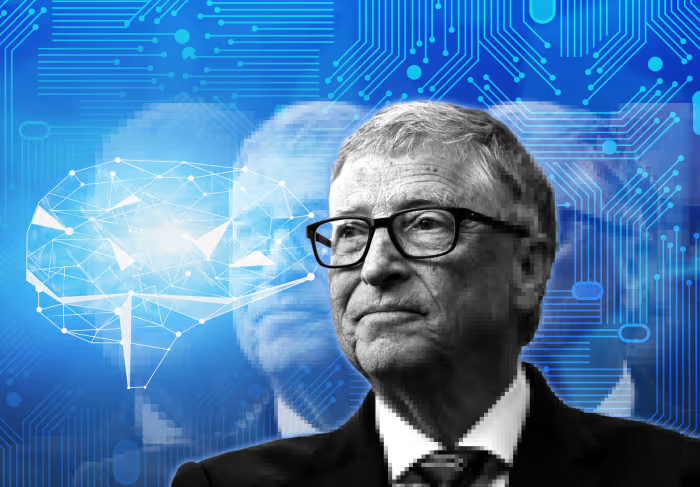
The Gates Foundation and OpenAI have partnered to deploy $50 million in health-focused intervention funding aimed at strengthening healthcare systems across Africa, with the programme set to begin in Rwanda.
The initiative, which will leverage artificial intelligence (AI) to improve healthcare delivery, was disclosed in a Wednesday report by Reuters. The project, named Horizon1000, will work closely with African governments to explore how emerging technologies can be applied to address persistent health challenges on the continent.
According to Bill Gates, Horizon1000 is designed to reach 1,000 primary healthcare clinics and surrounding communities across several African countries by 2028.
Gates, who has repeatedly described AI as one of the most transformative technologies ever developed, said the technology could play a critical role in addressing structural gaps in healthcare delivery.
“In poorer countries with enormous health worker shortages and lack of health systems infrastructure, AI can be a game-changer in expanding access to quality care,” Gates said.
Why the Intervention Matters
The investment comes at a time when many developing and low-income countries are grappling with declining support from international donors due to global budget cuts. Gates has previously warned that reduced aid is contributing to a rise in preventable child deaths, reversing decades of progress in global health.
African healthcare systems continue to face deep-rooted challenges, including chronic underfunding, weak infrastructure, and severe shortages of skilled health workers. These constraints have contributed to poor quality care, rising disease burdens, preventable deaths, and limited access to essential health services.
Most African countries also fall short of the Abuja Declaration, which recommends allocating 15% of national budgets to health, further weakening already fragile systems.
AI and Health Workforce Gaps
Gates noted that AI-driven interventions could be particularly valuable in regions with acute shortages of trained health professionals. Estimates suggest that sub-Saharan Africa faces a deficit of nearly six million healthcare workers, one of the largest workforce gaps globally.
As part of its broader AI-health strategy, the Gates Foundation established an AI Health Hub in Kigali, Rwanda, last year to support innovation, research, and scalable solutions tailored to African health systems.
Gates’ Longstanding Commitment to Africa
The Horizon1000 initiative builds on the foundation’s long-standing engagement with Africa’s health sector.
In 2025, during the Gates Foundation’s 25th anniversary of work in Africa, Gates pledged a $200 billion intervention fund, to be deployed over the next 20 years, with a significant portion earmarked for the continent.
“I recently committed to giving away my wealth over the next 20 years. The majority of that funding will be spent on helping you address challenges here in Africa,” Gates said at the time.
The funding is expected to support efforts to save lives, reduce preventable maternal and child deaths, and combat infectious diseases across the region.
Over the past two decades, the Gates Foundation’s health initiatives—working through platforms such as Gavi and the Global Fund to Fight AIDS, Tuberculosis, and Malaria—have reportedly contributed to saving more than 80 million lives.
Speaking on the future of the continent, Gates emphasised that Africa’s long-term prosperity depends on unlocking human potential through sustained investments in health and education.
“Our foundation has an increasing commitment to Africa. We’ve been here for over 20 years, and we will continue to work side by side with you to build a healthier and more prosperous future,” he said.



No Comment! Be the first one.