

2027: Interrogating The Outcomes of Nigeria’s General Election – Where IT Professionals are Excluded?
In this thought-provoking article, Chris Uwaje, foremost IT advocate, pioneer software engineer, former President of the Institute of Software Practitioners of Nigeria (ISPON), and a respected...

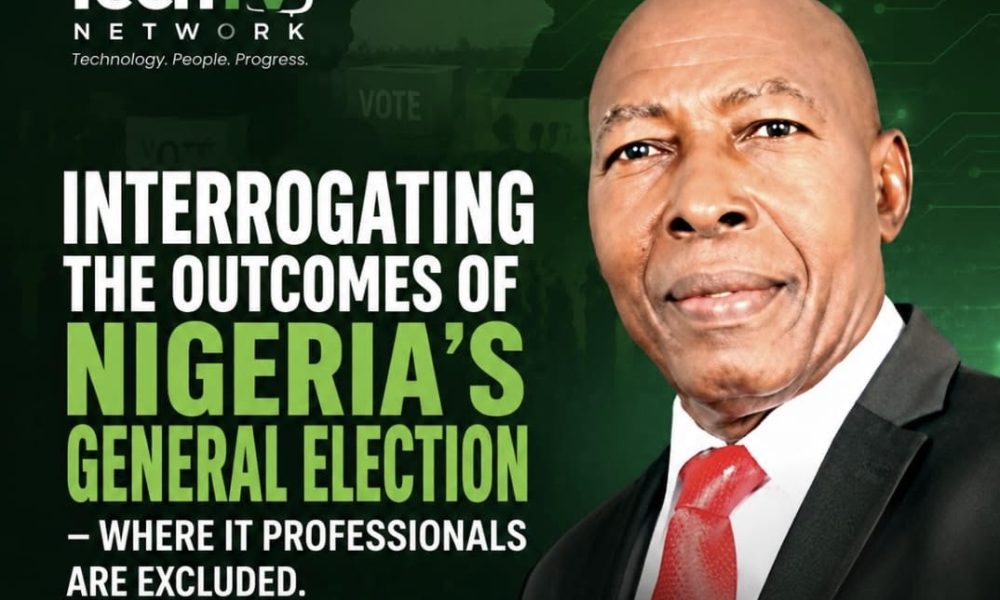
In this thought-provoking article, Chris Uwaje, foremost IT advocate, pioneer software engineer, former President of the Institute of Software Practitioners of Nigeria (ISPON), and a respected strategist in Africa’s digital ecosystem, examines the implications of excluding IT professionals from the nation’s electoral and governance architecture.
He argues that sustainable democracy, economic competitiveness, and digital sovereignty require the active participation of technology professionals in shaping Nigeria’s future…
The Puzzles! The fire Next Time! As we feverishly navigate towards the blazing future, the nation is tasked to interrogate the processes towards the 2027 general election – with the hindsight of 2023!
In that context, it becomes imperative to review the current INEC election-readiness status. And indeed, from the current landscape, ask, if indeed the 2027 National General Election is designed to be digitally delivered – without IT Professionals in charge? HOW? Perhaps as a monunent anticipated to fail?
In the begining, there were dreamers whose innovative Muse energised by Research, established the 0-9 digital ecosystem that continues to supercharge the cerebral faculty of our collective digital humanity.
They created, designed, tested and operationalized an incredible algorithm that remains the compass of civilisation today.
A digitally delivered electoral framework makes IT infrastructure under the control of IT Professionals a significant part and strategic imperative of the electoral process. And excluding IT professionals from key positions, translates to designing a system that can not be verified, defended, and/or be meritously explained.
Faulty electoral results are not just technical failure. Rather they amount to a legitimacy failure programmed to deliberately undermines the election purposes.
Conventional wisdom dictates that – for whatever reason/s, excluding IT professionals from manning the core and critical posts at a digitised national election process means we lose the brains who understand the phenomenal challenges of and how the system architecture actually works.
That disconnect supercharges the technical magnitude of electoral
failures. This is because they create security holes, loss of transparency, and a collapse in public trust. The deliberately presumed 2023 glitchy scenario at the orchestrated speed of Quantum Computing represents a vivid and heartbreaking example!
The characteristics of the true state of what would happen without IT professionals at the driver’s seat of digital electoral process include but not limited to the followings:
First is system failures and operational breakdowns – followed by blindfolded cover-ups by all means! Indeed, without IT professionals at all critical points to
configure, test, and maintain the Computing systems, basic failures occur on election day.
On D-Day, experiences show that systems power outages are prominent in the bouquets of failures! And even when there is power, central devices overheat, crash, or fail to transmit results. Meanwhile, not all failures are preconceived and executed.
Indeed, experiences from the 2023, General Election revealed that the e-transmission app wasn’t properly configured. The effect is that Voters collation officers were not able to upload vote tallies and had to manually carry result sheets to the central collation center.
Also, centralised systems experience information overload. Above all, uploaded results stalled for hours to register at the central Server. And
sometimes only 30% made it online.
With the above scenario, and in the absence of IT/Software Practitioners,
faulty clogs become a nightmare to diagnose.
And fixing the problems on time becomes a nightmare, because no one in the room understands the code or infrastructure.
Another key challenge is the loss of transparency and verifiability matters. Digitisation is supposed to make elections more transparent, but without IT expertise it often does the opposite: Results are delayed or unable to be uploaded in real-time.
Results collation room turns into a an intrest-market – a nightmare adventure! This is because issues classified as: “too difficult to detect errors” or “Man-in-the-middle” bug
manipulation. Bottom line: IT-experts were not on call to audit the system.
And perhaps one of themost critical nightmare is: ” Lockup Proprietary Source code. A scenario where vendors are locked’out. That means that even election management bodies can’t inspect what’s running behind the digital Screens!
Another prominent nightmare is the insider risks, which increases the challenges faced by IT professionals to mitigate the threats. This state increases the Hacking and manipulation factors.
In particular, the presence of
unauthorised third parties increases the vulnerabilities. This is, because thy can intervene at blind spots, making insider manipulation much easier.
As we are aware, Networked election systems have a complex attack surface that makes it to be actively exploited. Examples are:
– *Undetected attacks*: Internet voting and networked systems can be attacked in ways that “go completely undetected”.
– *Vendor dependency*: EMBs become dependent on vendors who have their own interests and may not be neutral. You get an uneven relationship where the EMB can’t specify or verify what it’s buying. 8bb74a8e0ed91174
4. *Erosion of public trust and legitimacy*
When tech fails or looks opaque, people assume the worst:
– Nigeria’s 2023 election saw widespread anger, accusations of tampering, and fuelled misinformation. Trust in the electoral commission was already low and didn’t recover.
– Kenya 2013 had a computer bug that multiplied disqualified ballots 8x, leading to claims of rigging. The Supreme Court later nullified the result over transmission failures.
– “The consequences of a failed election are much greater, and the adoption of e-voting has increased the risk that such failure will occur”. 55850334a71adba51174
5. *Opportunity costs and new vulnerabilities*
Tech can distract from basic electoral safeguards. When digital checks fail, the process can be _more_ vulnerable to rigging than before. You also get:
– High costs for purchasing/maintaining systems with reduced EMB control.
– A false sense of security that prevents addressing traditional risks like malpractice. 65a28bb750a2
*The pattern*: Countries that rushed digitisation without building internal IT capacity—Nigeria 2023, Kenya 2013—ended up with lower credibility than before. As one analysis puts it, ICT “has not resolved the crisis of electoral integrity in Africa, it has digitized it”!
IT professionals aren’t just “tech support.” They’re the people who make it possible to verify that the system wasn’t tampered with, to respond to incidents, and to explain to the public why the result is trustworthy.
*The case for putting IT professionals in key roles in a digitally delivered election*
If the electoral framework is designed to be digitally delivered, then treating IT as a back-office support function is a category error.
To run a legit, secure national election, you need more than just “IT guys”. It’s a whole team with different specialties. Think of it like layers – from infrastructure to security to public trust.
Here are the *critically necessary IT categories*:
*1. Infrastructure & Systems*
– *Network Engineers*: Build/maintain secure networks for voter registration databases, results transmission, polling station connectivity. Election networks must be isolated + redundant.
– *Database Admins/DBAs*: Manage voter rolls, candidate data, results databases. Accuracy + audit trails here are everything.
– *Cloud/Server Engineers*: If you use cloud for results portals or voter check-in, you need people who can scale systems for election-day traffic spikes.
*2. Security & Trust*
– *Cybersecurity Specialists*: Threat monitoring, penetration testing, intrusion detection. Elections are prime targets for DDoS, phishing, ransomware.
– *Cryptography/Security Engineers*: Handle encryption for data at rest + in transit, digital signatures for results transmission, secure ballot designs if you have e-voting.
– *Compliance/Audit IT*: Ensure systems meet legal standards. They create logs, chain-of-custody records, and audit trails so results can be verified.
*3. Application & Data*
– *Software Engineers/Developers*: Build/maintain voter registration portals, e-poll books, results management systems, public results websites.
– *QA/Test Engineers*: Break everything before election day. Load testing, failover testing, accessibility testing so disabled voters aren’t locked out.
– *Data Analysts*: Monitor turnout patterns, detect anomalies in results, create dashboards for election officials + observers.
*4. Operations & Support*
– *IT Support/Field Technicians*: Deploy and fix hardware at 1000s of polling stations. Biometric kits, printers, tablets, routers all fail at the worst time.
– *System Administrators*: Keep servers patched, backed up, and monitored 24/7 during election period.
– *Disaster Recovery/Business Continuity*: Plan for power outages, network failures, cyber attacks. What’s Plan B if results transmission dies?
*5. Governance & Integrity*
– *IT Policy/Legal Tech Experts*: Translate election law into technical requirements. Who has access to what? How long do you keep logs?
– *IT Project Managers*: Coordinate all the teams. Election timelines are immovable – you can’t delay due to a missed sprint.
*The non-negotiables*: Cybersecurity + Audit/Compliance + Database Admins. Without those 3, you can’t guarantee legitimacy even if everything else works.
The mix depends on your setup though. Paper-ballot + electronic results transmission needs different IT than full e-voting.
1. *You can’t govern what you don’t understand*
Digital elections create a complex stack: voter registration databases, biometric verification, results transmission, public portals, audit logs, cryptography. When IT professionals are excluded from key positions, the Electoral Management Body ends up outsourcing both the building and the understanding of the system.
Result: vendors set the specs, EMB staff can’t verify if the system matches the specs, and failures are blamed on “technical glitches” that no one inside can diagnose. Nigeria 2023 showed what happens when officers can’t even configure the e-transmission app. Strategic inclusion means having CTO-level roles inside the EMB with authority over architecture, procurement, and testing.
2. *Security and integrity depend on internal expertise*
Networked election systems have a “complex attack surface that malicious actors actively exploit”. Cyber, physical, and insider threats all target the digital layer.
IT professionals in key roles can:
– Design for verifiability and end-to-end audits, not just convenience.
– Spot insecure configurations before deployment.
– Respond to incidents in real time instead of waiting for a vendor.
– Ensure there’s no regulatory vacuum on cybersecurity standards.
Without them, you’re running critical infrastructure without the equivalent of a security team. That’s why experts argue IT security is “vital for the democratic process”.
3. *Trust is built on verifiability, not promises*
Digitisation was supposed to increase transparency and trust. In practice, when IT isn’t in the room, the opposite happens. In Nigeria 2023, only 30% of results appeared online despite a manual count claim, and it fuelled accusations of tampering. In Kenya 2013, a transmission failure and a bug that multiplied disqualified ballots 8x led to the Supreme Court annulling the result.
IT professionals can build systems where the public can verify outcomes without trusting a black box. That means open standards, reproducible counts, and clear audit trails—things that only happen if someone inside the EMB owns them.
4. *Procurement and vendor management need technical parity*
Outsourcing is useful, but “an uneven relationship between big IT companies and less knowledgeable government agencies” creates risk. When EMB leaders don’t understand the tech, contracts get written around vendor convenience, not electoral integrity.
Strategic inclusion puts IT professionals on procurement committees and vendor oversight boards. They can evaluate whether a system meets functional, security, and audit requirements, and hold vendors accountable. E-elections should “never be fully outsourced to commercial suppliers”.
5. *Operational resilience on election day*
Election day is unforgiving. Systems fail under load, devices overheat, networks drop. Polling officers trained only on user manuals can’t fix it.
IT professionals in regional and national operations centers can:
– Monitor system health in real time.
– Deploy patches or workarounds without waiting.
– Prevent a local failure from becoming a national legitimacy crisis.
Nigeria’s polling officers had to collect fuel money to cool overheating machines because there was no technical contingency plan.
What “mandatory and strategic inclusion” looks like in practice:
1. *Embed CTO/CISO roles* in the EMB with authority equal to legal and finance leads.
2. *Require technical sign-off* on all system design, procurement, and change requests.
3. *Build internal testing and audit teams* so the EMB isn’t dependent on vendor claims.
4. *Create a technical incident response unit* that operates during the election cycle.
5. *Mandate knowledge transfer* so EMB staff, not just contractors, understand the system.
*Bottom line:* A digitally delivered electoral framework makes IT infrastructure part of the electoral process itself. If you exclude IT professionals from key positions, you’re designing a system you can’t verify, defend, or explain. The result isn’t just technical failure—it’s a legitimacy failure that undermines the election’s purpose.

No Comment! Be the first one.