
Africa’s Borrow-to-Call Market Surges to ₦4.6 Trillion, Highlighting Growing Financial Strain
Africans borrowed a record ₦4.6 trillion worth of airtime credit in 2025, highlighting the growing role of mobile network operators as providers of short-term digital credit and underscoring the...

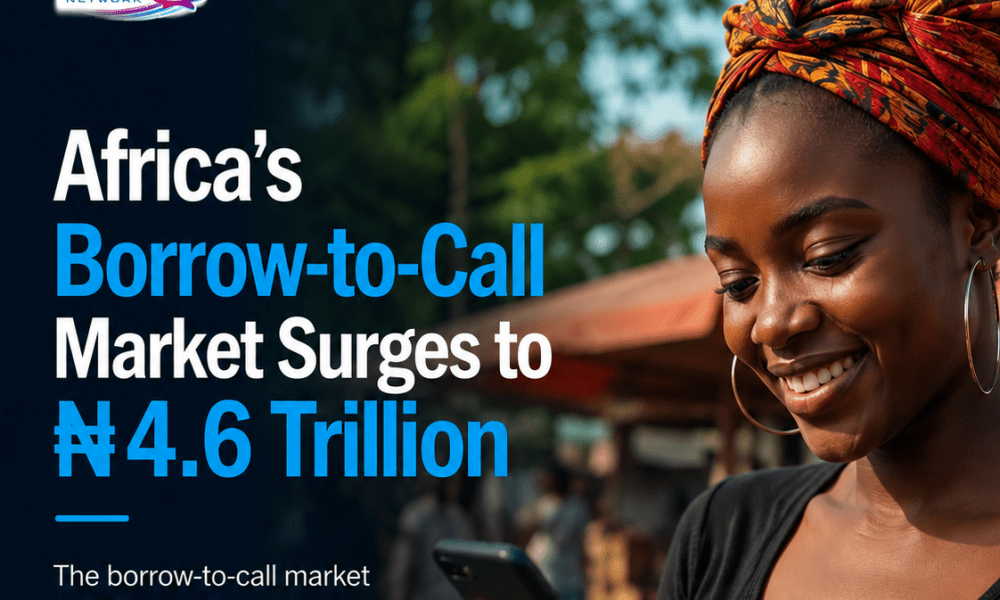
Africans borrowed a record ₦4.6 trillion worth of airtime credit in 2025, highlighting the growing role of mobile network operators as providers of short-term digital credit and underscoring the financial pressures facing millions of consumers across the continent.
According to financial disclosures from digital lending technology provider Optasia, mobile subscribers across Nigeria, South Africa, Kenya, and other African markets accessed approximately $3.18 billion in airtime advances during the year, equivalent to about ₦4.61 trillion. The figure represents an increase from the estimated ₦4.38 trillion recorded in 2024.
The surge reflects increasing dependence on so-called “borrow-to-call” services, which allow prepaid mobile subscribers to access airtime and data on credit and repay automatically after their next recharge.
Industry analysts say the trend demonstrates the growing importance of mobile connectivity in daily life, particularly as inflationary pressures, rising living costs, and irregular income streams continue to squeeze household budgets across Africa.
Africa Leads the Global Airtime Lending Market
Africa remains the world’s largest airtime lending market, accounting for more than 94 percent of all airtime credit disbursed globally in 2025, with total advances approaching $3 billion.
For millions of consumers, airtime lending has evolved from a convenience service into a critical financial lifeline, especially for individuals without access to traditional banking services, formal credit products, or emergency funding options.
The growth also reflects a broader shift in the convergence of telecommunications and financial services across emerging markets.
What began as a simple value-added telecom service has evolved into a sophisticated micro-credit ecosystem powered by behavioural analytics, automated repayment systems, customer data intelligence, and digital scoring models.
Regulatory Changes Reshape Nigeria’s Airtime Lending Market
In Nigeria, however, the airtime lending landscape is undergoing significant transformation.
Recent interventions by the Federal Competition and Consumer Protection Commission (FCCPC) have reclassified airtime and data advances as formal lending products, prompting a restructuring of the country’s estimated ₦400 billion annual airtime lending market.
The regulatory shift has led some telecommunications operators to suspend portions of their lending services amid ongoing legal and regulatory reviews.
Industry stakeholders believe the move could redefine how telecom-based credit products are regulated, monitored, and delivered going forward.
Banks Enter the Airtime Credit Business
The evolving regulatory environment has also created new opportunities for financial institutions.
Several Nigerian banks have begun introducing lower-cost airtime loan products, intensifying competition in a market that was traditionally dominated by mobile network operators.
The development signals a new phase in the evolution of digital lending, where telecom operators, fintech companies, and banks increasingly compete to provide accessible nano-credit solutions to consumers.
Growing Reliance Reflects Broader Economic Pressures
While airtime lending continues to support communication, commerce, and digital inclusion across Africa, experts warn that the growing dependence on nano-credit products may also reflect deeper economic realities.
Persistent inflation, declining purchasing power, limited access to affordable credit, and income uncertainty are driving more consumers toward short-term borrowing solutions to stay connected.
For many users, airtime advances have become an essential tool for maintaining access to communication services that support work, education, financial transactions, and social interaction.
The Future of Airtime Lending in Africa
As the boundaries between telecommunications, fintech, and banking continue to blur, airtime lending is increasingly emerging as an important pillar of Africa’s digital financial ecosystem.
Going forward, the sector’s trajectory will likely be shaped by evolving regulations, technological innovation, consumer protection requirements, and broader efforts to deepen financial inclusion across the continent.
For regulators, operators, banks, and fintech firms, the challenge will be balancing access to digital credit with responsible lending practices that protect consumers while supporting economic growth and digital participation.