



Aminu Maida Calls for Smarter Regulation to Power Nigeria’s Digital Economy at Titans of Tech 2026
The Executive Vice Chairman and Chief Executive Officer of the Nigerian Communications Commission (NCC), Dr. Aminu Maida, has called for a fundamental shift in Nigeria’s regulatory approach to...

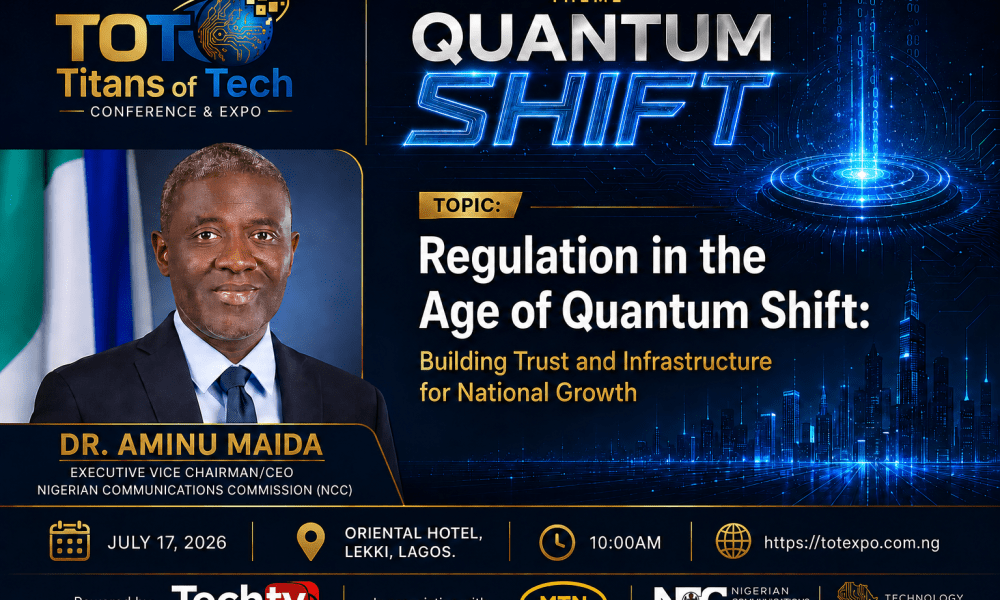
The Executive Vice Chairman and Chief Executive Officer of the Nigerian Communications Commission (NCC), Dr. Aminu Maida, has called for a fundamental shift in Nigeria’s regulatory approach to keep pace with rapid technological change, stressing that trust, resilient digital infrastructure and adaptive regulation will determine the country’s success in the emerging digital economy.
Delivering the keynote address at the Titans of Tech Conference & Expo 2026, Dr. Maida said regulators must evolve from being reactive rule-makers to proactive enablers of innovation capable of balancing technological advancement with consumer protection, national security and economic growth.
Speaking on the conference theme, “Regulation in the Age of Quantum Shift: Building Trust and Infrastructure for National Growth,” he described the current era as one of unprecedented technological transformation driven by artificial intelligence (AI), quantum computing, cloud technologies, blockchain, satellite communications, edge computing, the Internet of Things (IoT) and next-generation wireless networks.
According to him, while these technologies offer enormous opportunities to improve productivity, financial inclusion, healthcare, education, manufacturing and public service delivery, they also introduce new challenges around cybersecurity, privacy, digital sovereignty, market competition and consumer protection.
“The question before us is no longer whether technology will transform our economy. The question is whether our regulatory institutions can evolve quickly enough to ensure that technology serves society responsibly, securely and inclusively.”
Dr. Maida noted that regulation should no longer be viewed simply as a mechanism for correcting market failures but as a strategic tool for enabling innovation and long-term investment.
“Good regulation should not stifle innovation, neither should it permit unchecked technological advancement that undermines consumer rights, competition, national security or public trust,” he said.
He explained that the Nigerian Communications Commission has consistently reviewed its regulatory frameworks through spectrum management reforms, licensing innovations, consumer protection initiatives, infrastructure-sharing policies and quality-of-service monitoring to create an environment where innovation can flourish while safeguarding consumers.
Regulation Must Keep Pace with Innovation
The NCC chief argued that the accelerating pace of technological change demands equally agile regulatory systems.
He described the conference theme, “Quantum Shift,” as representing more than advances in quantum computing, saying it reflects a broader transformation across the digital ecosystem characterised by intelligent automation, converging industries, emerging business models and exponential technological advancement.
According to him, this transformation requires a corresponding shift from static regulation to adaptive regulation, from isolated policymaking to collaborative governance, and from reactive oversight to anticipatory regulation informed by research and stakeholder engagement.
Trust Is the Currency of the Digital Economy
A major focus of Dr. Maida’s keynote was the role of trust in accelerating digital adoption.
He argued that digital economies can only thrive when consumers trust that their personal information is protected, businesses have confidence in regulatory certainty, innovators believe creativity will be rewarded fairly and governments maintain citizens’ confidence in digital institutions.
“Trust is both an economic asset and a governance imperative.”
He said building trust requires transparency, consistency, accountability, stakeholder engagement and effective enforcement, while also strengthening cybersecurity and protecting increasingly interconnected communications infrastructure supporting banking, healthcare, education, transportation, commerce and public administration.
Preparing for the Next Wave of Emerging Technologies
Although practical quantum computing remains in its early stages, Dr. Maida said its long-term implications for cybersecurity, cryptography, communications, financial systems and scientific research will be profound.
He noted that artificial intelligence is already transforming network optimisation, customer experience, predictive maintenance, fraud detection and spectrum management, adding that tomorrow’s communications networks will increasingly rely on intelligent systems capable of self-optimisation and autonomous decision-making.
Preparing for that future, he said, requires sustained investment in research, standards development, regulatory capacity building and international collaboration.
“The regulator of tomorrow must understand emerging technologies sufficiently to regulate their impact without constraining their potential,” he said.
Collaboration Remains Essential
Dr. Maida stressed that no single institution can shape Nigeria’s digital future alone.
He called for stronger collaboration among government, regulators, telecommunications operators, technology companies, academia, civil society, investors and development partners to accelerate infrastructure deployment, strengthen cybersecurity, develop digital skills and expand innovation ecosystems.
According to him, sustainable regulation is achieved through consultation, transparency and partnership.
Nigeria’s Digital Opportunity
Highlighting Nigeria’s position as one of Africa’s largest digital markets, Dr. Maida said the country’s youthful population, entrepreneurial culture and expanding telecommunications sector provide a strong foundation for becoming a continental digital powerhouse.
However, he emphasised that achieving this vision will require continued investment in digital infrastructure, regulatory certainty, protection of critical national assets, digital skills development and consistent policy implementation.
He observed that while the telecommunications sector has already demonstrated its contribution to national economic growth, the next phase of development will depend on leveraging digital technologies across agriculture, education, healthcare, manufacturing, financial services, transportation and public administration.
“Our collective objective should be to ensure that regulation accelerates—not constrains—this transformation,” he said.
Concluding his address, Dr. Maida urged policymakers, regulators, industry leaders and innovators to work together in building a communications ecosystem that is secure, resilient, inclusive and globally competitive.
He reaffirmed the Nigerian Communications Commission’s commitment to fostering an enabling regulatory environment that promotes innovation, protects consumers, attracts investment, expands digital inclusion and supports sustainable national development.
“The age of Quantum Shift demands more than new technologies; it demands new thinking, stronger partnerships, smarter regulation, resilient infrastructure and, above all, enduring trust.”