
TSSF 7.0: Industry Calls for Rethink of Nigeria’s Digital Infrastructure Strategy
Industry leaders at the 7th Telecom Sector Sustainability Forum have called for a fundamental rethink of Nigeria’s digital infrastructure strategy, citing funding gaps, high deployment costs, rural connectivity challenges, data sovereignty concerns and regulatory bottlenecks as critical barriers to investment and innovation.
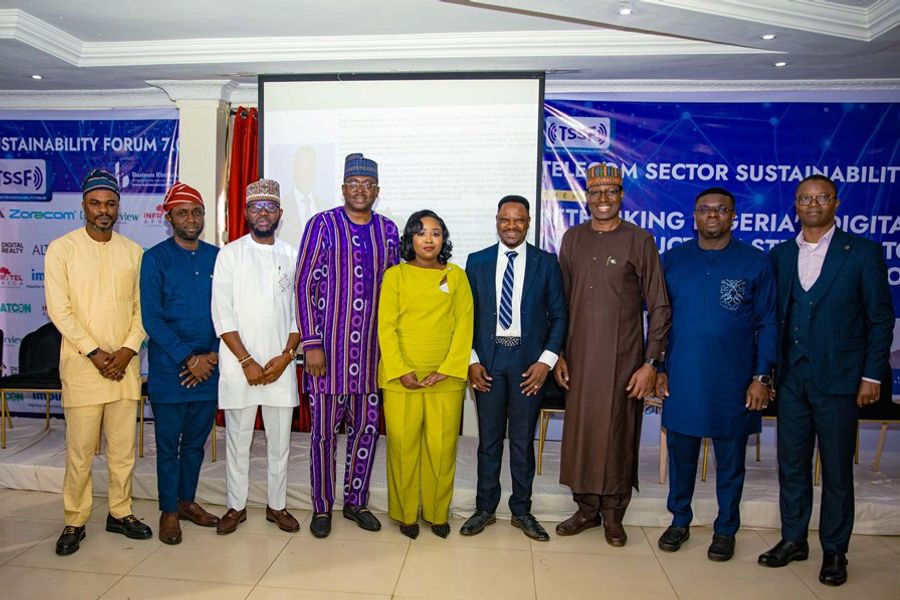
Nigeria’s digital infrastructure strategy requires a major rethink if the country is to attract the investment, build the capacity and unlock the innovation needed to compete in an increasingly digital global economy.
That was a major takeaway from the 7th edition of the Telecom Sector Sustainability Forum (TSSF 7.0), organised by Business Remarks at CitiHeight Hotel, Ikeja, Lagos, under the theme: “Rethinking Nigeria’s Digital Infrastructure Strategy to Attract Investment and Drive Innovation.”
The forum brought together telecom operators, policymakers, technology experts, infrastructure providers and innovators, with discussions focusing on the structural challenges limiting Nigeria's digital infrastructure expansion and the policy and investment measures required to address them.
$100bn Infrastructure Gap
One of the central concerns raised at the forum was the scale of Nigeria's digital infrastructure deficit.
Panelists estimated that the country could require approximately $100 billion over the next 30 years to close the gap, while noting that Nigeria remains significantly behind the digital infrastructure density of developed markets.
Industry stakeholders also pointed to upfront taxation, spectrum fees, licensing costs and right-of-way charges as significant constraints on capital deployment, with such costs estimated by the panel to consume as much as 50 per cent of capital expenditure in some cases. The forum called for a shift in policy thinking so that more capital can move into actual network deployment and infrastructure expansion.
Telecoms Industry Defends Its Contribution
Chairman of the Association of Licensed Telecoms Operators of Nigeria (ALTON), Gbenga Adebayo, said the telecom industry has recorded significant achievements throughout its more than 25-year history.
Adebayo urged industry stakeholders to communicate the sector's contributions more effectively, particularly its impact on society, education and national development. He also highlighted recent initiatives aimed at improving access to educational websites.
ALTON Executive Secretary and Chief Operating Officer, Ajibola Olude, meanwhile called for greater attention to talent development, rural inclusion and infrastructure investment.
He argued that the future of the digital economy depends not only on physical infrastructure but also on creating opportunities for people, businesses and communities. He also raised concerns about the cost of capital, with interest rates exceeding 30 per cent, and called for telecommunications to be treated as infrastructure underpinning other critical infrastructure.
Nigeria’s Data Sovereignty Question
A major dimension of the forum centred on the country's growing dependence on offshore cloud infrastructure.
Chief Executive Officer of Digital Realty Nigeria and Co-Chair of the National Cloud Initiative Technical Working Group, Engr. Ike Nnamani, said more than 80 per cent of Nigeria's sovereign data is currently hosted outside the country, describing the situation as a national risk.
Nnamani also said Nigeria could be losing substantial economic value to foreign cloud providers as government institutions increasingly adopt cloud services hosted outside the country.
According to him, only about 30 per cent of roughly 1,000 government agencies currently use cloud services, with annual spending estimated at about $1 billion. He said wider cloud adoption could substantially increase the market opportunity. He warned that reliance on offshore infrastructure creates potential sovereignty and continuity risks, particularly where critical national data is concerned.
National Cloud Initiative Takes Centre Stage
Nnamani said the National Cloud Initiative is designed to make cloud services operational within Nigeria's geographical boundaries, particularly for categories of critical data such as financial and national security information.
The initiative, he explained, is built around four pillars: regulation, implementation guidelines, governance and monitoring, and an investment guarantee framework. Government procurement under the framework would prioritise certified local cloud providers, while certification would be used to ensure that local providers meet global standards for security and quality.
He stressed that the initiative is intended to be private-sector driven, with government providing the policy and regulatory environment while businesses develop and operate the infrastructure.
The opportunity, he said, extends beyond cloud hosting to areas including data migration and systems integration.
Broadband: 57% Penetration, Rising Deployment Costs
Chief Operating Officer of WTES Group, Chidi Ajuzie, said broadband penetration remains around 57 per cent, despite mobile penetration of about 90 per cent.
He identified capital constraints, right-of-way challenges and regulatory fragmentation as major obstacles to fibre deployment.
Ajuzie specifically cited variations in right-of-way charges across states, noting that some states reportedly charge as much as ₦10,000 per metre, compared with the agreed ₦145 benchmark. He argued that right-of-way should be viewed as an economic enabler rather than simply an immediate revenue source.
He also pointed to India's BharatNet programme, which has deployed hundreds of thousands of kilometres of rural fibre, as an example Nigeria could study.
From Digital Consumption to Digital Production
Beyond infrastructure, TSSF 7.0 placed considerable emphasis on Nigeria's ability to turn connectivity into economic productivity.
Panelists argued that the country must move beyond being predominantly a consumer of digital services and develop stronger capabilities in digital skills, AI, machine learning, cloud computing and technology production.
The forum also identified rural connectivity as a persistent challenge, with infrastructure concentrated heavily in major urban centres.
Stakeholders called for greater infrastructure sharing, better mapping and data on existing infrastructure, and commercial frameworks that can make colocation and shared infrastructure more viable.
Cybersecurity Must Become Core Infrastructure
Cybersecurity also emerged as a major concern.
The panel argued that security should no longer be treated as an additional layer applied after infrastructure is deployed, but as a foundational component of infrastructure planning.
Business continuity, configuration management, compliance and proactive security investment were highlighted as essential to protecting increasingly interconnected digital systems.
A Decade or More to Close the Gap?
The forum's assessment was that Nigeria could require 10 to 15 years to significantly close its digital infrastructure deficit, although stakeholders stressed that stronger collaboration between government and industry could shorten that timeline.
The panel also projected that expanded open-access fibre, digital public infrastructure and local cloud could significantly increase the contribution of the digital economy to GDP by 2030.
With Nigeria's data-centre capacity also projected to expand substantially over the next five years, the forum positioned local infrastructure, cloud and data sovereignty as increasingly important components of the country's digital economic strategy.
The Infrastructure Test
TSSF 7.0 ultimately framed Nigeria's digital infrastructure deficit as both a challenge and an investment opportunity.
The forum called for policy reforms that reduce barriers to capital deployment, stronger infrastructure-sharing frameworks, increased investment in digital skills, expanded rural connectivity, local cloud capacity and cybersecurity, alongside policies capable of attracting and retaining long-term investment.
For Nigeria, the message from the forum was clear: the next phase of digital transformation will depend not simply on how many people are connected, but on whether the country can build, secure, finance and sustainably operate the infrastructure on which its digital economy depends.





Comments (0)
No comments yet. Be the first to join the conversation!
Leave a Reply
Your email address will not be published. Required fields are marked *