

Tech Titans Join Trump on China Visit
A powerful delegation of American technology leaders, including Jensen Huang, Tim Cook, and billionaire entrepreneur Elon Musk, has joined U.S. President Donald Trump in Beijing for high-level talks...

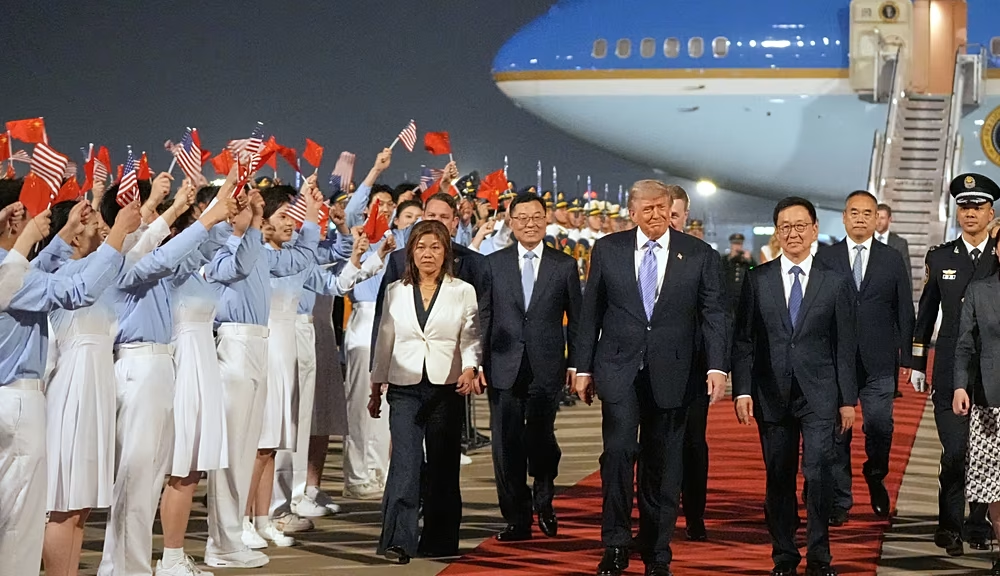
A powerful delegation of American technology leaders, including Jensen Huang, Tim Cook, and billionaire entrepreneur Elon Musk, has joined U.S. President Donald Trump in Beijing for high-level talks with Chinese President Xi Jinping.
The summit is aimed at improving U.S.-China economic relations, encouraging China to further open its market to American companies, and discussing key issues such as artificial intelligence, trade barriers, semiconductor access, and geopolitical stability.
Despite growing tensions between Washington and Beijing, many of America’s biggest tech firms remain deeply tied to China through manufacturing, supply chains, AI development, and consumer markets.
Nvidia’s Jensen Huang and China’s AI Ambitions
Jensen Huang, whose company Nvidia powers much of the global artificial intelligence boom, has long-standing business ties with both China and Taiwan.
Born in Taiwan before relocating to the United States as a child, Huang helped position Nvidia at the center of China’s AI growth. The company began working with Chinese universities as early as 2011, training students to use its CUDA software for AI engineering and machine learning.
By 2017, Nvidia chips were widely used by major Chinese technology companies, including Baidu, Tencent, and Alibaba through its AliCloud division.
However, U.S.-China tech tensions escalated in 2022 when former President Joe Biden imposed export restrictions on Nvidia’s advanced AI chips, including the A100 and H100 models, blocking their sale to China.
To navigate the restrictions, Nvidia later developed the H20 chip specifically for the Chinese market. Yet the company continued facing regulatory pressure from both Washington and Beijing, leading to billions of dollars in projected losses and a dramatic decline in Nvidia’s Chinese market share.
Chinese firms, including Huawei and AI startup DeepSeek, have since accelerated development of locally produced AI chips to reduce reliance on American technology.
Apple’s Tim Cook and the Manufacturing Empire Built in China
Tim Cook has perhaps one of the deepest business relationships with China among U.S. tech executives.
Before becoming CEO of Apple, Cook played a key role in moving much of Apple’s manufacturing operations to China in the late 1990s and early 2000s through partnerships with manufacturers such as Foxconn.
Over the years, China evolved into Apple’s global manufacturing hub, producing iPhones, iPads, Macs, and other products at massive scale.
Cook has also maintained close engagement with Chinese authorities, especially during periods of heightened trade tensions between the U.S. and China. Reports indicate he successfully lobbied against tariffs that could have significantly affected Apple’s supply chain and product pricing.
Apple also committed billions of dollars to China through investment agreements and energy initiatives aimed at supporting its long-term operations in the country.
Despite the success, Apple’s manufacturing partnerships in China have faced criticism over labour conditions, including allegations of excessive working hours and poor worker welfare at some supplier factories.
Elon Musk, Tesla, and China’s Electric Vehicle Boom
Elon Musk has built one of the strongest corporate relationships with China through Tesla.
Tesla initially struggled after entering the Chinese market in 2013, with analysts questioning whether the country’s early-stage electric vehicle sector could support the company’s ambitions.
However, the company later staged a remarkable turnaround. In 2019, Tesla launched its massive Shanghai Gigafactory — the company’s first major manufacturing plant outside the United States.
The facility quickly became one of Tesla’s most important production hubs globally, manufacturing millions of vehicles and helping the company expand rapidly across Asia and Europe.
China has since become a critical market for Tesla, both as a manufacturing base and as one of the world’s largest electric vehicle markets.
A High-Stakes Meeting Between Tech and Geopolitics
The Beijing summit highlights the complicated relationship between America’s biggest technology companies and China at a time of rising geopolitical competition.
While Washington continues tightening restrictions around AI chips, advanced semiconductors, and strategic technologies, companies like Nvidia, Apple, and Tesla remain heavily dependent on China for manufacturing, sales, talent, and market growth.
For China, maintaining relationships with leading American technology firms remains strategically important as the country seeks to strengthen its position in artificial intelligence, electric vehicles, semiconductors, and digital infrastructure.
The outcome of the meetings could shape the future of global technology, trade relations, and the AI race between the world’s two largest economies.

No Comment! Be the first one.