
Finland Advances Wireless Electricity Technology as Researchers Push the Limits of Cable-Free Power
Researchers in Finland are advancing wireless power-transfer technologies that can deliver electrical energy across an air gap without conventional cables, although the technology remains largely limited to controlled environments and relatively short distances.
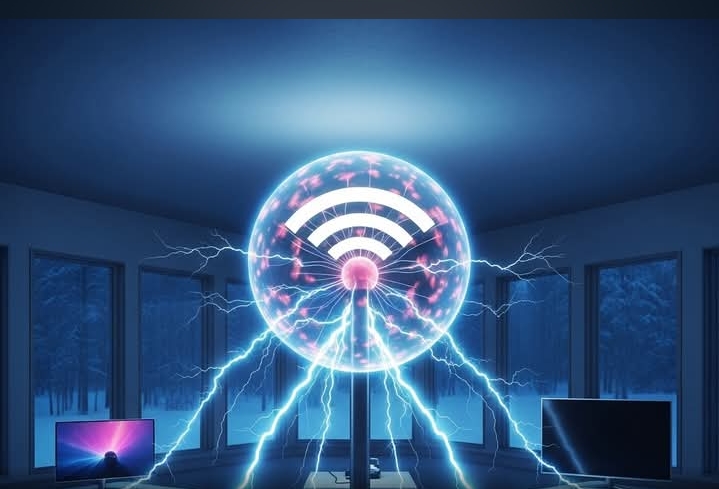
Finland is emerging as a notable centre for research into wireless power transfer (WPT) technology that enables electrical energy to move between a transmitter and receiver without a physical electrical connection.
Contrary to viral claims that Finland has begun transmitting large amounts of electricity freely through the open air, researchers have not replaced conventional power grids or demonstrated city-scale cable-free electricity transmission. Instead, Finnish universities and research teams are developing increasingly sophisticated systems for transferring power over controlled distances.
At the heart of the technology is the use of electromagnetic fields, inductive coupling, magnetic resonance and, in some systems, radio-frequency energy to transfer power from a transmitting unit to a receiving device.
Researchers at Aalto University, for example, have investigated wireless power-transfer systems designed to improve efficiency and allow greater freedom in the positioning of receiving devices. A 2024 doctoral study examined challenges including power-transfer efficiency, positioning and system losses.
Another line of research at Aalto has explored mid-range wireless power transfer using two loop antennas. The researchers reported that, under optimized conditions, radiation losses could be reduced, potentially extending the useful distance of wireless power systems beyond conventional near-field arrangements.
The research is also moving into applications involving multiple devices.
A 2026 doctoral dissertation from the University of Oulu examined RF wireless power transfer for simultaneously delivering energy to multiple devices, while highlighting continuing limitations such as propagation losses and hardware constraints.
What does “electricity through the air” actually mean?
Wireless power transfer does not mean electricity behaves like a conventional current flowing through a copper cable suspended in the atmosphere.
Instead, electrical energy is converted into electromagnetic energy at a transmitter and subsequently captured and converted back into usable electrical power by a receiver.
The approach is already familiar in technologies such as wireless phone charging, but researchers are working to increase the distance, efficiency, positioning flexibility and amount of power that can be transferred.
Finnish research has included systems capable of operating at power levels well beyond small consumer charging applications, although efficiency generally becomes more challenging as the distance between transmitter and receiver increases.
The major challenge: distance
One of the biggest obstacles facing wireless electricity is efficiency.
Aalto researchers note that conventional inductive wireless power systems can achieve relatively high efficiency when the transmitter and receiver are sufficiently close, but efficiency can fall significantly as the distance increases. Their research into radiation suppression and optimized antenna interactions is aimed partly at addressing this problem.
This means the technology currently has much more realistic applications in wireless charging, industrial systems, robotics, electric mobility and connected devices than in replacing national electricity transmission networks.
Finland's work nevertheless illustrates an important direction in energy technology: reducing dependence on physical connectors and enabling electrical devices to receive power automatically or with minimal physical contact.
As wireless power research advances, the long-term possibilities could include charging systems embedded in floors, roads, workspaces and transport infrastructure, as well as more flexible power delivery for the expanding Internet of Things.
For now, however, the headline should be understood as an advance in wireless power-transfer research—not the arrival of a cable-free national electricity grid.





Comments (0)
No comments yet. Be the first to join the conversation!
Leave a Reply
Your email address will not be published. Required fields are marked *