
Ten Female CEOs Driving Nigeria’s Digital Economy
From telecommunications infrastructure and fintech to identity management, cybersecurity and digital trust, these ten women are helping shape the businesses, systems and leadership driving Nigeria’s digital transformation. In this TechTV Network feature, we spotlight ten female CEOs and technology leaders whose work spans critical areas of Nigeria’s digital ecosystem
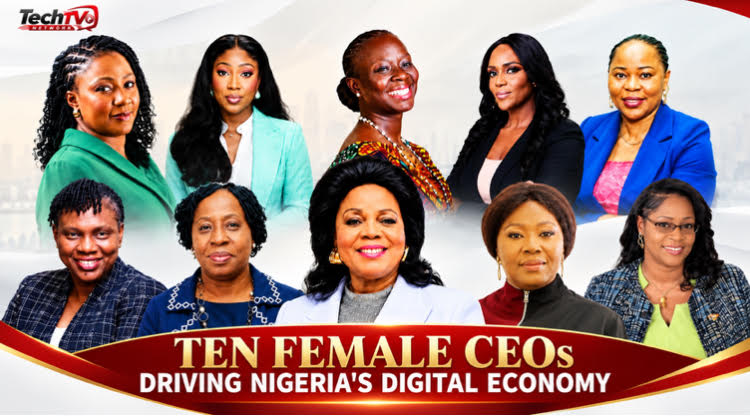
From telecommunications infrastructure and digital connectivity to financial technology, identity management, cybersecurity and enterprise communications, women are playing increasingly important roles in shaping Nigeria’s digital economy.
Their contributions extend beyond corporate leadership. They are building technology businesses, expanding access to digital services, strengthening financial systems, developing communication solutions and helping organisations navigate an economy increasingly powered by data and innovation.
Among them are Funke Opeke, Chioma Ekeh, Maggie Peters, Mayowa Olaniyan, Happiness Obioha, Fatumata Soukouna Coker, Juliet Ehimuan-Chiazor, Jameelah Sharrieff-Ayedun, Adesuwa Imasekha and Roseline Ilori.
Operating across different segments of the technology ecosystem, these ten executives represent a cross-section of the leadership helping to advance Nigeria’s digital transformation.
1. Funke Opeke — MainOne (Equinix
Few Nigerian technology entrepreneurs have had as significant an impact on the country's international internet connectivity as Funke Opeke.
As the founder of MainOne, Opeke led the development of a private submarine communications cable that connected Nigeria and other West African markets to international internet infrastructure. Launched in 2010, the system helped expand broadband capacity and support the growth of internet-dependent businesses across the region.
MainOne subsequently developed terrestrial fibre-optic networks and data centre infrastructure, including its MDXi facilities, strengthening the foundations upon which digital businesses, cloud services and online platforms operate.
The company was acquired by Equinix in 2022, marking a significant milestone in the development of West Africa's digital infrastructure market.
Opeke's contribution illustrates the importance of infrastructure investment to digital transformation. Behind every online transaction, streaming service, cloud application and digital enterprise lies a network of physical systems that makes connectivity possible.
Her work has helped bring that infrastructure conversation to the centre of Nigeria's digital economy.
2. Chioma Ekeh — Technology Distributions
Chioma Ekeh has established a prominent position in Nigeria's technology distribution sector through her leadership of Technology Distributions, a company involved in connecting global technology brands with businesses and consumers across the country.
Technology distribution is a critical but sometimes overlooked component of the digital economy. It provides the commercial link between manufacturers of computers, enterprise systems, software and other technology products and the organisations that depend on them.
Through this ecosystem, businesses can access the tools required for digital operations, while technology partners gain a route into Nigeria's growing market.
Ekeh's work highlights the importance of supply chains, partnerships and market development in building a sustainable technology industry.
As organisations increase their adoption of digital tools, the role of technology distributors in making products available, supporting deployment and connecting vendors to customers remains essential.
Her leadership represents the commercial side of digital transformation, where access to technology is translated into business opportunities and wider market participation.
3. Maggie Peters — Alpha Technologies Limited
Maggie Peters, Managing Director of Alpha Technologies Limited, operates in a segment of the digital economy where communication services meet business innovation.
Under her leadership, Alpha Technologies has developed communication solutions designed to help businesses improve customer engagement, strengthen brand identity and manage their telephone services more efficiently.
The company pioneered special numbering services in Nigerian telecommunications, including 0800 toll-free and 0700 non-toll-free numbers. These services gave businesses alternative ways to establish recognisable contact points and improve communication with customers.
Its offerings also include Alpha Outbound, which allows businesses to use customised caller identification, and Alpha PBX, a wireless intercom solution. Other services include interactive voice response systems and audio conferencing for large groups.
One of the company's consumer-facing innovations is the Alpha Caller app, which enables users to make calls to Nigeria over internet connections at advertised low rates. The service is designed to help Nigerians at home and abroad maintain affordable communication links.
Peters’ leadership impact lies in expanding how businesses use telecommunications to compete, connect and serve their customers. By championing solutions that make organisations more accessible and their communication systems more adaptable, she has helped advance a business-oriented approach to telecom innovation—one that prioritises practical utility, customer experience and commercial relevance over connectivity alone.
Her industry contributions received formal recognition in 2024 when she was inducted into the Nigerian ICT Industry Hall of Fame at the Titans of Technology Awards. In the same year, Alpha Technologies won the Pioneer Special Numbering Service Provider of the Year Award, acknowledging its pioneering contribution to Nigeria’s special numbering services segment.
These honours distinguish both the individual and the enterprise: Peters for her leadership in a specialised field of communications technology, and Alpha Technologies for its place in the evolution of Nigeria’s business communication services.
Her profile underscores the importance of indigenous technology leadership in building solutions that respond to real market needs and support the wider digital transformation of Nigerian commerce.
4. Mayowa Olaniyan — Chams Holding Company Plc
Mayowa Olaniyan leads Chams Holding Company Plc, a Nigerian technology group with interests spanning identity management, financial technology, voting technology and human resource solutions.
With more than 28 years of professional experience across technology, finance, strategy, audit and business operations, Olaniyan brings a combination of financial discipline and technology-sector experience to her role as Group Managing Director and Chief Executive Officer.
Before her appointment to lead Chams Holding Company, she served as Managing Director and CEO of Chamsmobile Limited, where she oversaw a portfolio of digital financial services, including mobile money and agency banking.
Her career within the Chams Group has also included responsibilities in finance, internal audit, risk management, corporate services and strategy.
This breadth of experience is relevant to a technology market in which innovation must be supported by effective governance, operational efficiency and sustainable business models.
Chams' activities in identity technology and digital financial services place the group within important parts of Nigeria's digital infrastructure.
Under Olaniyan's leadership, the company's challenge and opportunity lie in scaling technology-driven services that support businesses, institutions and individuals in an increasingly connected economy.
Happiness Obioha — Tizel Global
Happiness Obioha is a Nigerian technology executive, cybersecurity strategist and data protection professional whose work focuses on helping organisations navigate the risks and opportunities of an increasingly connected economy.
As Chief Executive Officer of Tizel Global, she leads a technology solutions company providing cybersecurity, digital risk protection, network security and managed technology services. Her role places her at the intersection of enterprise technology adoption and the growing need to protect the systems, data and digital infrastructure on which modern businesses depend.
Under her leadership, Tizel’s service portfolio spans cybersecurity advisory, software development, data protection compliance, vulnerability management, cloud and data security, firewall protection, fraud prevention and cybersecurity training. The company also provides solutions for managing privileged access, monitoring database activity and strengthening organisational defences against emerging cyber threats. These capabilities address a critical requirement for businesses embracing digital payments, cloud computing, online services and data-driven operations.
Obioha’s approach to cybersecurity extends beyond conventional perimeter defence. She has advocated stronger intelligence-led security strategies that account for the evolving tactics of cybercriminals, including AI-enabled fraud, identity theft, deepfakes and attacks targeting digital payment systems.
She has also called for Africa to develop stronger homegrown cybersecurity intelligence, arguing that effective protection must account for the continent’s distinctive digital environments, business practices and threat patterns. The position connects cybersecurity with broader questions of digital sovereignty, institutional resilience and the capacity to protect critical information infrastructure.
Beyond her leadership at Tizel, Obioha serves as Regional Sales Director at Tecom Concepts Limited, where her professional experience includes technology business development and solutions involving fibre optics, radio frequency infrastructure and data centres. This combination of cybersecurity and connectivity experience gives her a perspective that spans both the infrastructure enabling digital services and the security required to sustain them.
Her career, spanning more than a decade in technology-related business and leadership roles, has included positions in sales, account management, business development and country management. This commercial background is relevant in a sector where cybersecurity providers must translate complex technical capabilities into practical solutions that organisations can deploy and sustain.
In 2025, Tizel Cybersecurity received the Digital Transformation Company of the Year award at the Technology Africa Awards, while Obioha was recognised as Outstanding Woman in Tech at the Titans of Tech Awards. These recognitions brought additional attention to her work in a field increasingly central to enterprise competitiveness and national digital development.
For Nigeria, the stakes are substantial. As organisations expand their digital footprints, the ability to prevent cyberattacks, protect sensitive information, maintain service availability and build customer trust will influence how confidently businesses and public institutions adopt emerging technologies.
Through her leadership at Tizel Global, Happiness Obioha represents a dimension of Nigeria’s digital economy that is sometimes less visible than consumer applications and connectivity: the security expertise and technology services required to make digital growth sustainable.
Her place among the female executives featured in Ten Female CEOs Driving Nigeria’s Digital Economy reflects the growing importance of women leading businesses that protect, enable and strengthen the country’s digital infrastructure.
6. Fatumata Soukouna Coker — YGroup Holdings Inc.
Fatumata Soukouna Coker brings extensive international technology and corporate leadership experience to her role as CEO of YGroup Holdings Inc.
Her career includes experience with major global technology companies such as IBM and Microsoft, where she worked across areas involving technology, business development and emerging markets.
Her professional experience has extended across Africa, the United States and the Middle East, giving her exposure to different approaches to technology adoption, market expansion and enterprise development.
Beyond YGroup Holdings, Coker serves as Chairman of the Board of CreditRegistry, Nigeria's credit bureau, and has held leadership and board positions in financial services and other organisations.
Her work across technology and financial services reflects the growing convergence between digital infrastructure, data, financial information and economic participation.
Credit information systems, for example, can help lenders make more informed decisions, improve risk assessment and support the development of credit markets.
Coker's experience demonstrates how technology leadership increasingly intersects with corporate governance, investment, financial inclusion and the development of institutions that support economic growth.
7. Gozy Ijogun — Task Systems Limited
Gozy Ijogun, Managing Director and Chief Executive Officer of Task Systems Limited, represents a generation of business leaders combining commercial strategy, technology expertise and enterprise leadership to advance Nigeria’s digital economy.
Her experience in building and scaling the enterprise provided a foundation for her appointment as Managing Director and CEO of Task Systems
Under her leadership, Task Systems is focused on delivering integrated information and communications technology solutions to organisations across banking, oil and gas, telecommunications, manufacturing and the public sector. The company’s portfolio and implementation experience span enterprise infrastructure, software, technology deployment and support services.
This positioning is increasingly significant as Nigerian organisations accelerate digital transformation, modernise legacy systems and invest in the infrastructure required to improve productivity, operational resilience and customer experience.
For businesses operating in complex and competitive markets, successful digital transformation goes beyond acquiring new technologies. It requires the integration of reliable systems, appropriate technology solutions, skilled professionals and sustained technical support to ensure that digital investments deliver measurable business value.
Ijogun’s experience across technology distribution and enterprise ICT solutions reflects an understanding of both sides of this equation: making technology accessible to the market and enabling organisations to deploy it to solve practical business challenges.
Her leadership at Task Systems places her within an important segment of Nigeria’s digital economy, where enterprise technology providers help translate digital ambition into operational capability.
As artificial intelligence, cloud computing, cybersecurity and data-driven business processes continue to reshape industries, the role of integrated ICT solutions providers will remain central to helping Nigerian enterprises adapt, innovate and build for sustainable growth.
Through her leadership at Task Systems Limited, Gozy Ijogun represents the enterprise technology dimension of women’s leadership in Nigeria’s digital transformation.
8. Jameelah Sharrieff-Ayedun — CreditRegistry Nigeria
Jameelah Sharrieff-Ayedun, Managing Director and CEO of CreditRegistry Nigeria, brings an extensive background in engineering, software technology, business management and financial information systems.
She is a co-founder of CreditRegistry Corporation, a software technology company headquartered in the United States, and was appointed substantive Managing Director and CEO of CreditRegistry Nigeria in 2014.
Under her leadership, the company reported substantial growth in profitability. She also played a role in expanding the organisation's reach across Nigeria's commercial banking sector.
Before her work at CreditRegistry, Sharrieff-Ayedun held positions at Microsoft Corporation, including programme management roles in China and the United States. Her earlier career included experience at General Motors across several international markets.
Her background in electrical engineering and technology management has helped shape a career spanning technical systems, business development and organisational growth.
Credit information is a critical component of a functioning financial system. By helping lenders assess borrowers' credit histories and financial behaviour, credit bureaus can support better-informed lending decisions and the development of a stronger credit culture.
As Nigeria seeks to expand access to finance for individuals and businesses, reliable credit information and technology-enabled risk assessment remain important.
Sharrieff-Ayedun's career places her at the intersection of software technology, financial information and the infrastructure required to support a more inclusive digital economy.
9. Adesuwa Imasekha — TAI Corp
Adesuwa Imasekha, Group Chief Executive of TAI Corp, brings experience in investment management, development finance and corporate strategy to the intersection of technology, infrastructure and economic development.
With nearly two decades of professional experience, her work encompasses areas including energy transition, digital transformation and inclusive economic growth.
She also serves as Director of Technology, Energy and Infrastructure for an African credit fund, with investment interests spanning information and communications technology, clean energy and smart infrastructure.
These sectors are closely connected. Data centres require reliable power, telecommunications networks depend on resilient infrastructure, and digital services need investment to scale sustainably.
Imasekha's professional focus reflects the importance of viewing technology not as an isolated industry but as part of a broader economic system involving energy, capital, infrastructure and public policy.
She is also the founder and president of Women Impacting Nigeria, an organisation that promotes women's empowerment through initiatives involving financial inclusion, digital skills, entrepreneurship and STEM education.
Her work connects investment and infrastructure development with the need to expand economic opportunities for women and girls.
As Nigeria pursues greater digital capacity and more resilient infrastructure, leaders who can connect capital allocation, technology and sustainable development will remain important to the country's long-term economic ambitions.
10. Roseline Ilori — Bridge57 Solutions Limited
Roseline Ilori is a technology and compliance executive whose work focuses on digital trust, cybersecurity, data privacy and responsible technology adoption.
As founder and CEO of Bridge57 Solutions Limited, she works at a time when organisations are increasingly confronted with questions about data protection, artificial intelligence governance, cyber risks and the responsible use of digital systems.
Her experience includes serving as CEO of MTech Communications Plc, where she led digital business activities across Nigeria and other African markets.
Ilori is also a co-founder and trustee of Women in Data Privacy and serves as Deputy Chairperson of the ICT Sectorial Group of the Lagos Chamber of Commerce and Industry.
Her work reflects a growing priority for businesses and governments: digital transformation must be accompanied by safeguards that protect information, manage risks and strengthen public confidence.
As companies deploy artificial intelligence and expand their use of digital platforms, questions of accountability, privacy and security have become central to technology governance.
For Nigeria, building a trusted digital economy requires not only connectivity and innovation but also the frameworks, expertise and institutional practices needed to protect users and organisations.
Ilori's work in digital trust and responsible technology addresses this increasingly important dimension of the country's digital future.
Beyond Leadership: Building Nigeria's Digital Future
The experiences of these ten women illustrate the diversity of leadership shaping Nigeria's technology landscape.
From the submarine cables and data centres underpinning internet connectivity to the software, financial information systems, enterprise communications and governance frameworks supporting digital services, their areas of work touch different parts of the technology value chain.
Their careers also demonstrate that the digital economy requires more than technical expertise. It depends on investment, strategic leadership, financial management, effective regulation, skilled people and the ability to translate innovation into services that businesses and citizens can use.
Yet significant challenges remain. High infrastructure costs, unreliable power, cybersecurity threats, limited access to finance and the digital skills gap continue to affect the growth of technology businesses.
Expanding women's participation in technology leadership also requires sustained investment in education, mentorship, entrepreneurship and opportunities to lead and own technology-driven enterprises.
Recognising women already operating in these sectors is an important part of the conversation, but the wider objective must be to create an environment in which more women can build successful technology companies, influence policy and contribute to the development of digital infrastructure.
For Nigeria, the stakes are economic as much as social. A stronger digital economy can support productivity, create jobs, expand financial access and improve the competitiveness of local businesses.
The women featured here represent different approaches to that opportunity. Their collective experience underscores a central point: Nigeria's digital transformation will depend not only on the technologies it adopts, but also on the people, institutions and leadership capable of turning those technologies into lasting economic value.
WHAT YOU NEED TO KNOW
Nigeria's digital economy depends on an interconnected ecosystem of telecommunications infrastructure, financial technology, identity systems, enterprise communications, cybersecurity, data governance and investment. The ten women featured in this article lead or have held leadership positions in businesses and organisations operating across these areas.
WHY IT MATTERS
Women's leadership in technology expands the range of expertise, experience and perspectives shaping business innovation and digital development. Supporting women-led technology enterprises and strengthening access to investment, skills and leadership opportunities can help Nigeria build a more competitive, inclusive and resilient digital economy.




Comments (0)
No comments yet. Be the first to join the conversation!
Leave a Reply
Your email address will not be published. Required fields are marked *