
Nigeria’s Recycling Goldmine: Experts Demand Investment, Policy Enforcement
Nigeria’s waste stream could become a major economic resource, but experts say unlocking the opportunity will require long-term financing, stronger policy enforcement, modern infrastructure, technology and behavioural change.
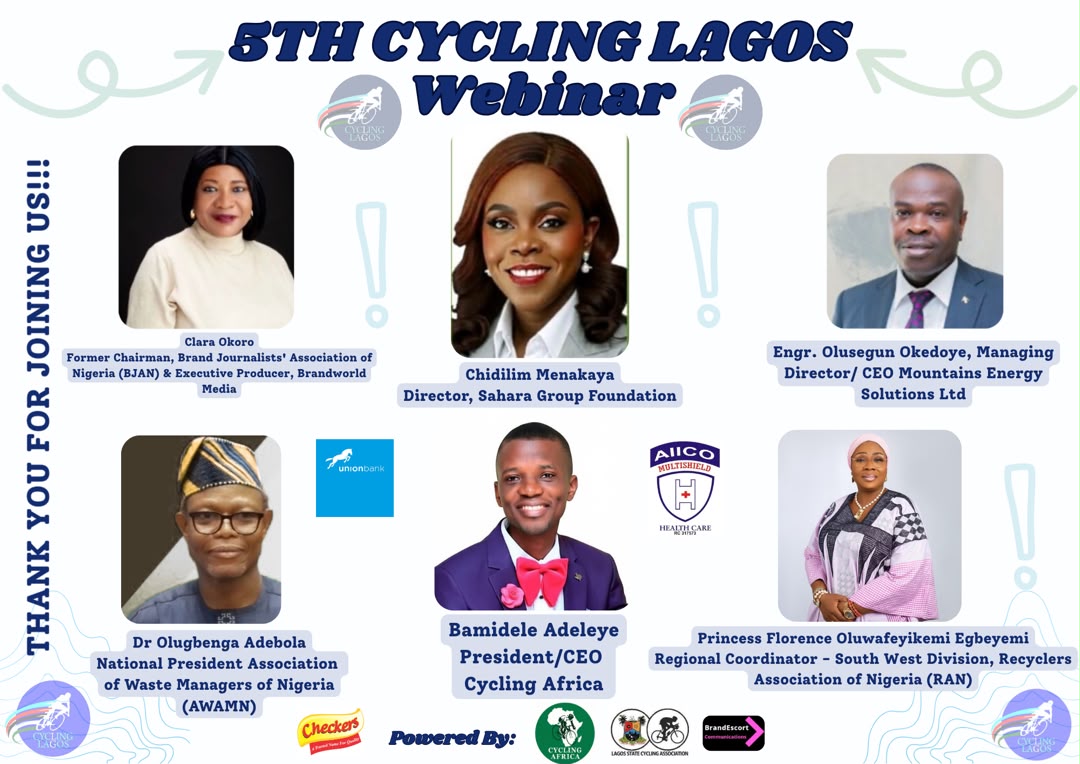
Nigeria’s growing waste stream could become a major source of jobs, industrial raw materials and economic value if government and the private sector address critical gaps in financing, infrastructure, policy enforcement, technology and public awareness, experts have said.
The call was made at the 5th Cycling Lagos Webinar, held on Thursday, September 3, 2026, ahead of the 5th Cycling Lagos event scheduled for September 12 at the National Stadium, Surulere, Lagos.
The webinar, themed “Trash to Treasure: Unlocking Recycling Capacity for a Sustainable Future,” brought together waste managers, recycling practitioners, environmental advocates and private-sector stakeholders.
The National President of the Association of Waste Managers of Nigeria (AWAMN), Dr. Olugbenga Adebola, said Nigeria must stop treating waste solely as an environmental problem and recognise its economic potential.
“Waste is not waste unless you waste it.”
Adebola said inadequate infrastructure, high financing costs and weak policy implementation were limiting the growth of the recycling sector.
He advocated 10- to 15-year financing arrangements for recycling and waste-management infrastructure, noting that short-term commercial loans and high interest rates were unsuitable for the capital-intensive industry.
He also called for stronger government-private sector partnerships and long-term concessions to give investors the confidence to commit substantial capital.
The Director of Sahara Group Foundation, Chidilim Menakaya, said private-sector investment was critical to building efficient collection, sorting, processing and recycling systems.
“Most of this waste is actually wasted instead of being turned into opportunities.”
Menakaya, however, stressed that infrastructure alone would not solve the problem without behavioural change, urging stronger public education on the environmental and economic benefits of recycling.
She also highlighted technology as an important enabler, citing recycling data dashboards and reverse vending machines as examples of innovations that can improve efficiency across the value chain.
Meanwhile, the Regional Coordinator, South-West Division of the Recyclers Association of Nigeria, Princess Florence Oluwafeyikemi Egbeyemi, said recycling must be elevated from a sanitation activity to industrial policy, urban infrastructure and resource security.
She argued that success should be measured not simply by the amount of waste collected, but by how much is transformed into quality industrial feedstock with reliable buyers.
Her investment formula was straightforward:
Predictable feedstock + predictable quality + predictable buyer = bankability.
Egbeyemi also called for stronger implementation of Extended Producer Responsibility (EPR), greater integration of the informal recycling sector and material-specific strategies for plastics, metals, paper, organics, e-waste and construction waste.
The Managing Director/CEO of Mountains Energy Solutions Ltd, Engr. Olusegun Okedoye, identified weak enforcement, inadequate infrastructure and limited public awareness as major barriers.
“Government has a lot of policies, there is no doubt about it, but the enforcement of those policies is nearly non-existent.”
He called for sustained investment in waste infrastructure, environmental education and technology transfer, alongside a predictable policy and investment environment.
Across the webinar, the experts agreed that Nigeria’s recycling opportunity requires a coordinated ecosystem involving government, investors, manufacturers, recyclers, waste managers, communities and consumers.
They identified data, infrastructure, finance, technology, markets, policy enforcement and behavioural change as critical to transforming Nigeria’s waste challenge into a circular-economy opportunity.
Opening the webinar, Cycling Africa Limited President/CEO and Convener of Cycling Lagos, Bamidele Adeleye, said the “Trash to Treasure” campaign was designed to connect environmental awareness with practical action and economic opportunity.
The 2026 Cycling Lagos will hold on Saturday, September 12, 2026, at the National Stadium, Surulere, Lagos.
The webinar was moderated by Clara Okoro, former Chairman, Brand Journalists’ Association of Nigeria and Managing Director, Brand World TV.


Comments (0)
No comments yet. Be the first to join the conversation!
Leave a Reply
Your email address will not be published. Required fields are marked *